USM Haller Storage: Using Drawers, Inner Panels & Flip Doors
A modular piece of furniture compatible with USM Haller looks calm and tidy from the outside – but it's the interior fittings that decide whether it stays that way. With flip doors, pull-out trays (drawers) and inner panels you turn an open shelf into a piece of furniture where everything has its place. Here you'll learn which parts do what, how to combine them and which ideas work well in the living room, home office, kitchen and children's room.
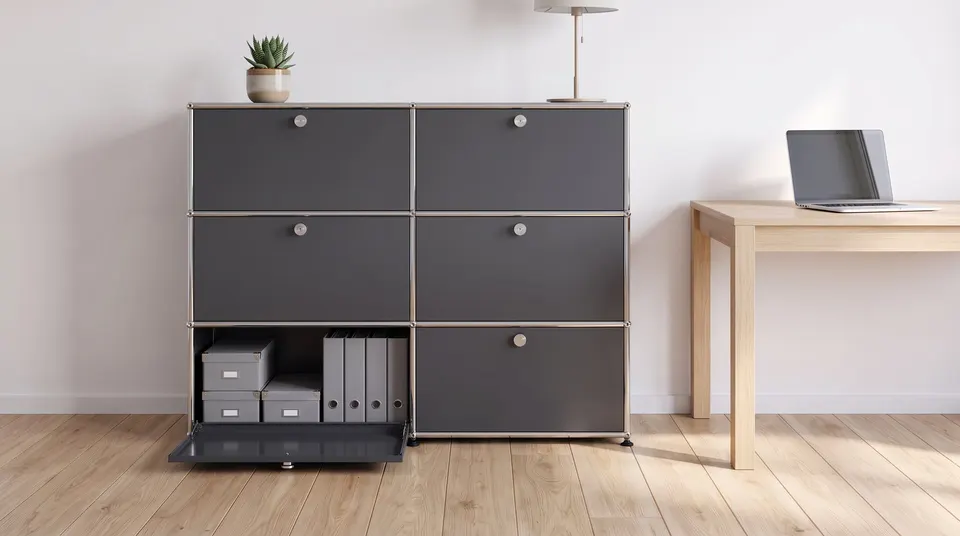
The principle: grid first, fittings second
Every compartment in the system has a fixed grid size, measured from ball centre to ball centre. Common widths are 75, 50 or 35 cm, heights are usually 35 cm, and the depth in our shop is 35 cm. All fronts, shelves and pull-outs are made to fit this grid. That's the big advantage: you can leave a compartment open today and add a flip door or a drawer later, without buying a new piece of furniture.
Before ordering parts, ask one simple question for each compartment: should you be able to see inside, reach in quickly, or should the contents disappear? The answer almost automatically tells you whether a compartment stays open, gets a drawer or hides behind a flip door.
The building blocks at a glance
Flip doors: contents out of sight
Flip doors close a compartment completely. They open upwards or downwards – a door opened downwards becomes a handy surface, for a laptop or a pile of mail, for example. Our shop offers flip doors in 35 × 35, 50 × 35 and 75 × 35 cm in eleven RAL colours (as of October 2026: €49.90 / €59.90 / €69.90). The door comes without fittings. You'll also need the spring hinge set (hinge with scissor holder, spacer bracket, screws and clamps); our configurator calculates two sets per door. The soft-close damper makes the flip door close slowly and quietly, and a door handle with key makes the compartment lockable – ideal for documents or medication.
Pull-out trays (drawers): quick access
A pull-out tray is a shelf that slides forward on runners. Small items, cables, remote controls or cutlery stay neatly arranged and within easy reach. The shop offers pull-out trays in 75 × 35 and 50 × 35 cm, together with drawer runners (1 pair including screws, with soft-close self-retraction). If you want a coloured front in front of the pull-out, the T-bracket connects the front panel to the pull-out – creating a closed drawer that looks like a flip door from the outside.
Inner panels: dividers between compartments
An inner panel is the vertical divider between two compartments placed side by side. It splits a wide piece of furniture into separate compartments: nothing slides into the neighbouring compartment, and dust and views stay separated from the one next to it – handy when an open compartment sits next to one with a flip door. On furniture with two rows in depth, an inner panel likewise separates the front row from the back row. The shop offers inner panels in 35 × 35 cm (depth × height) in all shop colours. Horizontal shelves and top panels, on the other hand, are always outer panels.
Open compartments: for display
Not every compartment needs to be closed. Open compartments look light and suit books, plants or favourite pieces. If you want to display items, combine a glass outer panel with glass panel holders – the compartment stays visible but protected from dust.
Table: compartment fittings at a glance
| Fitting | Ideal for | Parts from the shop |
|---|---|---|
| Flip door | Devices, files, supplies – anything you don't want to see | Flip door, 2 × spring hinge set, optional soft-close |
| Lockable flip door | Documents, valuables, medication | as above + door handle with key |
| Pull-out tray (drawer) | Small parts, cables, cutlery, remote controls | Pull-out tray, drawer runners (pair), optional T-bracket for a front |
| Inner panel | Separating compartments from each other | Inner panel 35 × 35 cm |
| Open compartment | Books, boxes, decoration | Outer panels only |
| Glass compartment | Display pieces, glasses | Glass outer panel + glass panel holders |
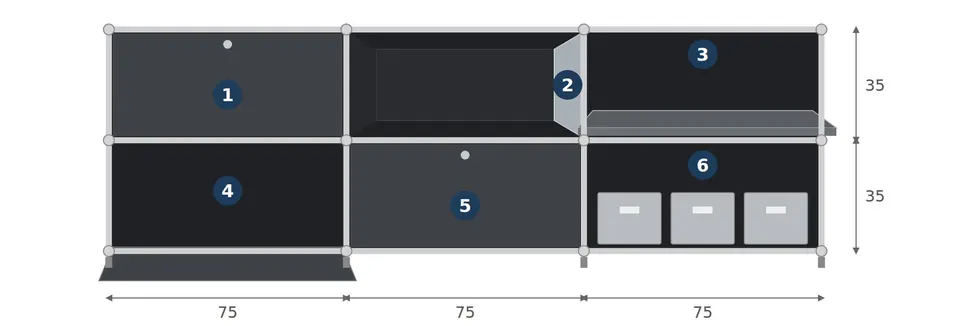
Key: 1 closed flip door · 2 inner panel as divider between two compartments · 3 pull-out tray (drawer) · 4 flip door opened downwards as a surface · 5 lockable flip door · 6 open compartment with boxes.
Ideas for every room
Living room
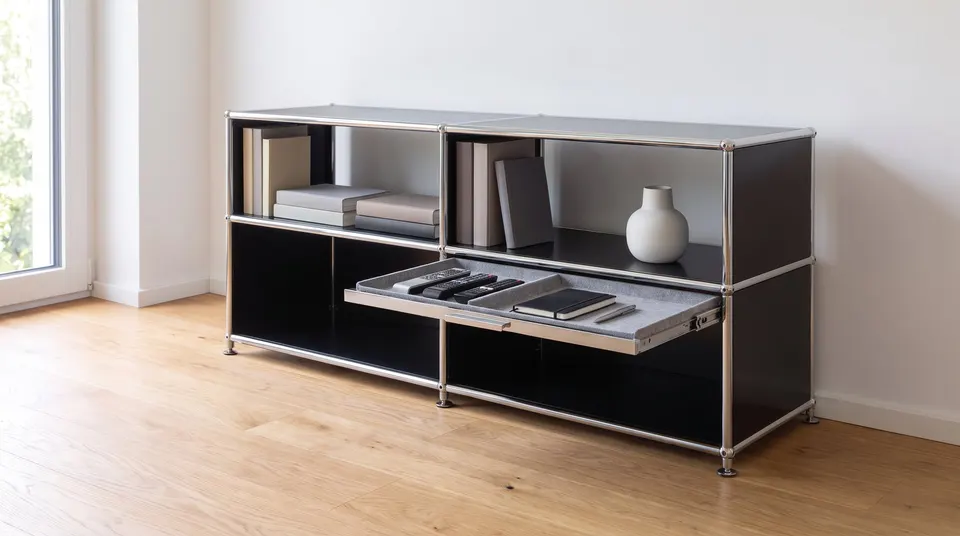
In a lowboard or sideboard, remote controls, charging cables and console accessories belong in a pull-out tray. Devices such as a receiver or games console go behind a flip door; leave out a back panel there or plan space for cables. An open compartment in the middle stays free for books or a vase – so the furniture doesn't look like a closed block.
Office and home office
This is where combining a lockable flip door with a drawer pays off: contracts and tax documents are locked away, while pens, notepads and USB sticks sit in the pull-out. A door folded down serves as a short-term surface for the laptop. For heavy contents such as files, you can secure shelves additionally: with a tube with hole and the screw for shelf fixing, the panel is fastened to the tube and carries loads more securely. Measure the clear inside dimensions of your compartment before buying files or boxes – grid sizes refer to the ball centres, the inside is slightly smaller.
Kitchen and dining room
In a sideboard next to the dining table, cutlery, napkins and coasters fit into a drawer, glasses and carafes behind a flip door or in a glass compartment. For plates and bowls, stackable plate racks or standard shelf inserts create a second level. A magnetic faux-leather pad on the top protects the surface when you put down drinks or food.
Children's room
Open compartments with boxes at the bottom so children can tidy up themselves, flip doors with soft-close above for everything not needed every day. Important: in a children's room, always secure taller furniture and furniture with pull-outs to the wall so nothing can tip over when someone climbs or hangs on an open drawer.
Boxes and inserts
The manufacturer offers its own boxes for the compartments. We don't sell them – but you don't necessarily need them. Standard boxes, baskets or felt inserts work just as well, provided they fit the clear inside dimensions. Our tip: two or three smaller boxes per compartment rather than one big one you have to pull out completely every time.
How to plan your fittings
- Collect the contents: What should go into the furniture? Sort roughly into "display", "quick access" and "store away".
- Assign compartments: Frequently used items at hip height, heavy items at the bottom, rarely used items at the top or behind doors.
- Choose parts: Decide on flip door, drawer or open for each compartment, plus inner panels as dividers where compartments should be separate – colours can be mixed.
- Check in the configurator: In the free 3D configurator you can see the result and get a complete parts list including all fittings.
Frequently asked questions
Can I add drawers and flip doors later?
Yes. Because all parts are made for the grid, open compartments can be upgraded at any time. A drawer needs a pull-out tray and drawer runners, a flip door needs the door and two spring hinge sets.
Which flip door size do I need?
The size depends on the width and height of the compartment: 35, 50 or 75 cm wide at 35 cm high. What counts is always the grid size from ball centre to ball centre.
How do I load drawers and shelves correctly?
Distribute heavy items evenly and place them as low as possible. For heavy contents you can also fasten shelves to the tube using tubes with holes and the shelf-fixing screw. On tall furniture, never pull out several fully loaded pull-outs at once, and secure the furniture to the wall.
Do boxes from other brands fit?
Yes, if the dimensions are right. Measure the clear inside dimensions of the compartment – width, height and depth between the panels – and choose boxes slightly smaller so you can take them out easily.