Plants on a USM Haller Shelf: Ideas, Placement & Care Tips
Chrome, clean lines and powder-coated steel – a USM Haller piece looks precise and a little cool. That is exactly why plants suit it so well: leaves soften the strict geometry and the green adds warmth to the room. Whether it is an open shelf, a sideboard or a narrow herb stand by the window, here you will find out which plants work, how to avoid water marks and scratches, and how to turn your furniture into a plant shelf with compatible parts.
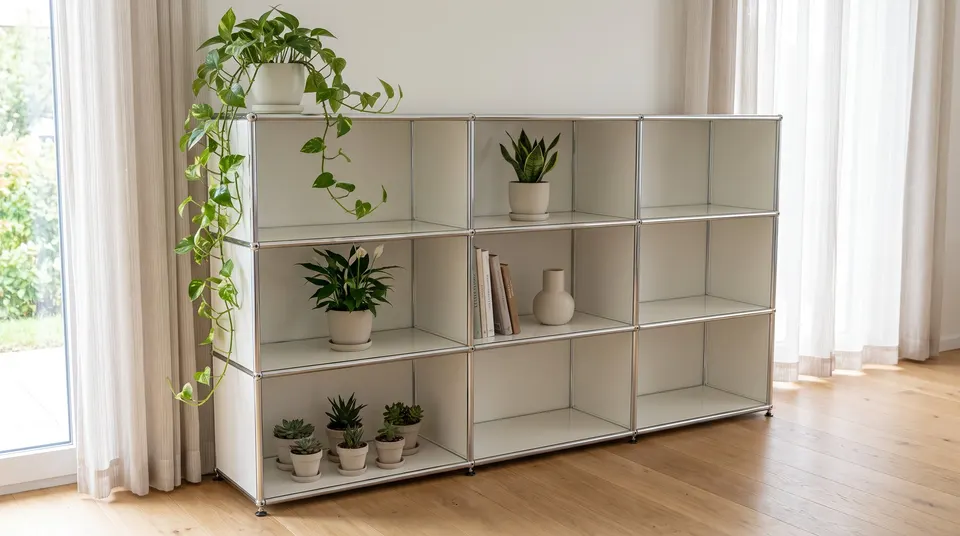
Why plants and modular furniture go so well together
The system is based on a fixed grid: from ball centre to ball centre a compartment is 75, 50 or 35 cm wide and usually 35 cm high, with a depth of 35 cm. Each compartment is like a small frame – ideal for showing off individual plants as if in a display case. Alternate open compartments with books, vases or baskets and the shelf looks lively without feeling cluttered.
Another advantage: an open shelf can stand freely in the room. If you leave out the back panels in individual compartments, it becomes a green room divider that lets light through and separates two areas – such as dining and living space – without closing them off. Important: the panels (side and back panels) brace the tube frame. For the furniture to stay stable it needs enough of them – so do not leave them all out. A free-standing room divider should rather be low and wide.
Which furniture shape for which plant?
- Open shelf (e.g. 3 × 3 compartments): perfect for many small and medium plants. Trailing plants like pothos or philodendron at the very top, compact plants in the compartments below.
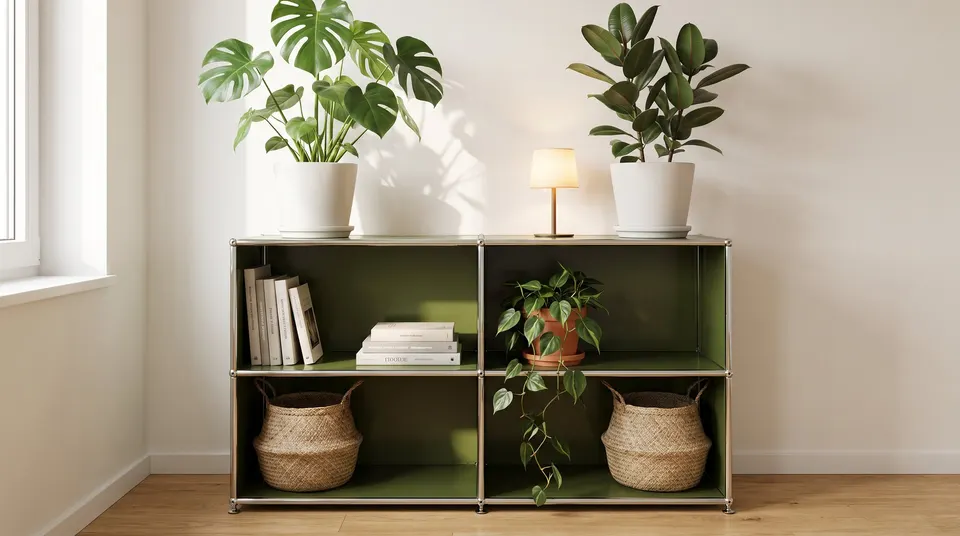
- Sideboard and lowboard: the top is a stable, level surface for larger plants such as monstera, rubber plant or bird of paradise. Underneath you keep storage behind flap doors or in open compartments.
- Narrow shelf, one compartment wide: open compartments with a back panel and, if needed, individual side panels make an airy plant étagère – ideal for herbs by the kitchen window. The panels keep the shelf stable; secure a narrow, tall shelf to the wall as well.
- Room divider: individual compartments without a back panel, plants visible from both sides. Choose robust plants that do not need much light.
Plants that work particularly well
A standard compartment is 35 cm high on the grid. So that leaves do not touch the top, a plant inside a compartment should stay clearly lower including its pot – around 30 cm is a good guideline. With a depth of 35 cm, pots up to about 18–20 cm in diameter fit comfortably. Anything larger is better placed on top.
| Plant | Light | Water needs | Best spot |
|---|---|---|---|
| Pothos | bright to partial shade | medium | at the top, let the vines hang down |
| Snake plant (Sansevieria) | bright to shady | low | in a compartment, even away from the window |
| ZZ plant (Zamioculcas) | partial shade | low | in a compartment or on the lowboard |
| Peace lily | partial shade | medium to high | in a compartment, check regularly |
| Succulents, cacti | very bright, sunny | very low | compartments close to the window |
| Spider plant | bright | medium | at the top or in a compartment |
| Kitchen herbs | sunny | medium to high | open levels right by the window |
| Monstera, rubber plant | bright, no harsh sun | medium | on top of a sideboard or lowboard |
Plants with very high water needs are rather impractical in furniture – the more often you water, the greater the risk of drops on the metal.
Light: placement is everything
Plants deep inside a compartment get less light than on top, and a closed back panel shades them further. Place the shelf at a right angle to the window if you can, so that light falls into the compartments. Light-hungry plants belong in the front compartments close to the window; shade-tolerant species such as snake plant or ZZ plant cope further back. If it is too dark, a standard plant light placed on top helps. Turn the pots every few weeks so the plants grow evenly.
Watering without water marks: how to protect your furniture
The panels are powder-coated steel, the tubes and balls are chrome-plated. Both are easy to care for, but neither likes standing water. A few habits keep your furniture looking new despite the plants:
- Always use a saucer or cachepot: no pot without a saucer, no soil directly on the metal. A cachepot without a drainage hole with an inner pot is the safest solution.
- Take pots out to water: water small pots in the sink, let them drain and only then put them back.
- Wipe drops away immediately: dry water on panels or chrome straight away with a soft cloth. Low-lime water (e.g. left to stand or filtered) prevents white rings.
- Check the saucers: do not leave water standing in the saucer – it harms the roots and, in the long run, the surface too.
- Soft base: felt or cork pads under heavy ceramic pots prevent scratches in the coating.
- Mineral substrate or hydroculture: less loose soil, less dirt in the compartments.
For cleaning, a soft cloth and a mild, neutral household cleaner are all you need. Abrasives and strongly acidic or alkaline cleaners are off limits. If you spot a chip in the coating, touch it up promptly so that no moisture reaches the steel.
Weight and stability
A large pot with wet soil quickly becomes heavy. Place large plants on top of a sideboard or lowboard and spread the weight across the surface instead of loading a single compartment. Very large planters are better on the floor next to the furniture. On tall shelves with plants in the upper compartments the centre of gravity is higher – secure such shelves to the wall, especially if children or pets live in the household.
Glass top and castors: two ideas for plant lovers
Glass as a top: a toughened safety glass (ESG) outer panel instead of the metal top lets light into the uppermost compartment and does not mind water. Limescale marks are very visible on glass, though – so wipe it briefly after watering here too.
Plant trolley on castors: swap the levelling feet for swivel castors and a small lowboard or narrow shelf becomes a mobile plant or herb trolley. In summer you roll it to the sunny window, in winter away from the radiator. Choose lockable castors so nothing moves while you water.
Planning your plant shelf
First decide where the furniture will stand and how much light reaches that spot. Then define width and height: for a plant corner by the window a shelf one or two compartments wide is often enough, as a room divider three compartments or more look impressive. Colours such as pure white, light grey or olive green make the green of the plants stand out especially well. In the free 3D configurator you put your shelf together and immediately see which parts you need – from tubes and balls to panels.
Frequently asked questions
Does watering damage the powder-coated panels?
Individual drops do not, as long as you wipe them off quickly. Standing water over a longer period is the problem, for example under a leaking pot. With a saucer or cachepot and a quick wipe you are on the safe side.
How big can a plant be for one compartment?
A standard compartment is 35 cm high and 35 cm deep on the grid. Plant and pot together should not exceed about 30 cm in height, and pots up to about 18–20 cm in diameter fit well. Put larger plants on top.
Are there special plant inserts for USM Haller?
The manufacturer USM offers its own metal elements with cut-outs for pots under the name “Plant Worlds”. We do not sell these. With ordinary pots on saucers, open shelves and our compatible parts you can still create a beautiful plant shelf.
Can I use a shelf with plants as a room divider?
Yes. Leave out the back panels in individual compartments so that light passes through and the plants can be seen from both sides. For the furniture to stay stable it needs enough panels (side or back panels) – do not leave them all out. A free-standing room divider should rather be low and wide, or securely fixed to the floor or to adjoining furniture.